How mature is your AI program? Find out in 4 minutes Start the Assessment

Apigee AI Gateway: Building a Secure Foundation for Enterprise AI

As a Google Cloud Apigee partner, NeosAlpha delivers Apigee as one gateway for both your APIs and your AI traffic, with security, token budgets, and full visibility built into every model call, MCP tool, and agent handoff.
Apigee and Google Cloud partner

Control Model Sprawl

One governed endpoint for every model and provider

Control Agent Sprawl

Every agent authenticated, scoped, and on the record

Control MCP Sprawl

Every MCP tool registered, filtered, and secured

Know Your AI Spend

Token usage and cost by team, model, and agent

Apigee API Gateway,
Extended to AI Traffic

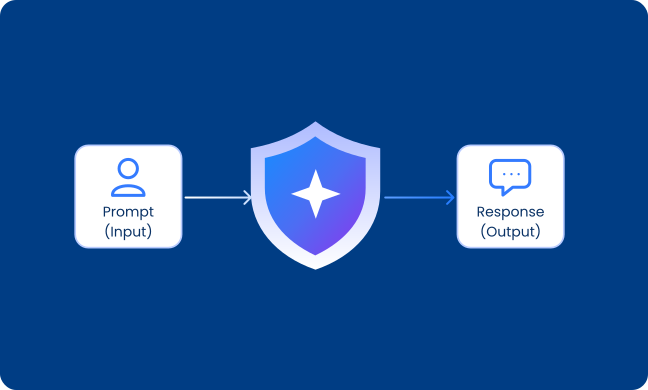
Apigee is a proven API gateway for authenticating requests, enforcing quotas, protecting backend systems, and reporting on every call. AI traffic needs the same controls, yet in most organizations it bypasses any gateway, flowing straight from applications and agents to model providers and MCP servers with no policies applied.

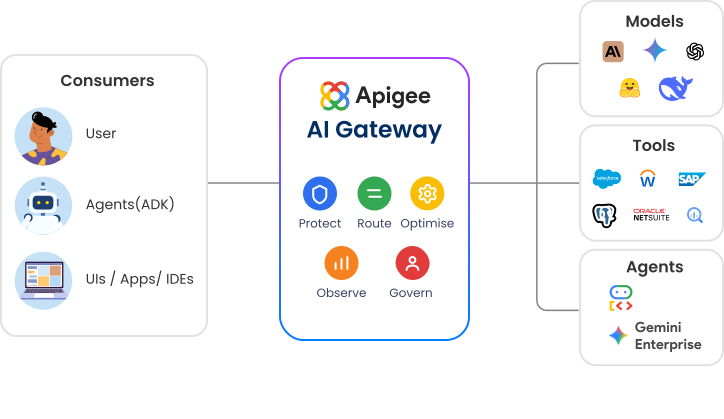
Apigee AI Gateway brings that traffic under control. LLM calls, MCP tool calls, and agent-to-agent (A2A) requests run through Apigee proxies and API products, where AI-specific policies such as token quotas, Model Armor screening, semantic caching, and model routing work alongside standard API controls like authentication, rate limiting, and analytics. Whether you already run APIs on Apigee or are starting fresh, one gateway handles both APIs and AI, with one set of policies and one view of every request.

One Apigee platform for APIs and AI: users, agents and apps connect through Apigee to models, tools and agents
WITHOUT APIGEE AI GATEWAY

AI Traffic Outside Your API Program

  • Model API keys copied into apps, notebooks, and scripts
  • Prompts and responses leave the network with no screening
  • Token spend that shows up only on the monthly invoice
  • MCP servers and agents reaching business systems unchecked
  • Controls in place for APIs, none for AI
WITH APIGEE AI GATEWAY

AI Traffic Inside Your API Program

  • Model access issued through API products, scoped by team or app
  • Model Armor screening on every prompt and response
  • Token quotas, semantic caching, and chargeback by consumer
  • MCP tools and A2A calls authenticated, rate-limited, and logged
  • APIs, models, tools, and agents governed from one Apigee platform

The Key Challenges of
Enterprise AI Adoption

Enterprise AI rarely stalls because the models are weak. It stalls because spend, data, access, and accountability go ungoverned while usage grows. These are the six gaps we see most often, and each one can be closed at the gateway.

Unpredictable AI Costs

AI spend grows faster than anyone planned. No one owns the budget, the same questions get paid for again and again, and costs can’t be traced back to the teams running them.

Data Exposure

Customer and company data can end up inside AI requests without anyone noticing. Inaccurate or harmful responses can reach customers and damage the brand.

No Control Over Who Uses What

Teams adopt AI models on their own, with no central view of who is using which model, for what purpose, or at what cost. Shadow AI becomes the norm.

Service Disruption

When an AI provider slows down or goes offline, customer-facing services stop with it. Every request also defaults to the most expensive option, whether it needs to or not.

Agents Acting Beyond Their Remit

Agents can reach into business systems and take actions on their own. Without limits on what they can access, a single agent can touch far more than it should.

Accountability Gaps

Agents now hand off work to other agents and can even make payments. When something goes wrong, there is no clear record of who approved what, which creates compliance and audit risk.

Our Apigee AI
Gateway Services

Whether Apigee already runs your APIs or you are choosing an AI gateway for the first time, our services cover each stage, from the first architecture decision to day-to-day operations.

AI Gateway Strategy and Architecture

AI Gateway Strategy and Architecture

Our architects review your current API and AI setup, model providers, and agent roadmap, then define the target design: deployment model, environment layout, and the policies that run at each stage.

Apigee AI Gateway Implementation

Apigee AI Gateway Implementation

Stand up AI proxies, connect your model providers and identity provider, and configure the Model Armor, token quota, and semantic caching policies your risk team has approved.

MCP and Agent Enablement

MCP and Agent Enablement

Turn your existing APIs into governed MCP tools through Apigee, register them in API Hub, and route A2A and AP2 traffic through Apigee with authorization and audit logging in place.

AI Security and Compliance

AI Security and Compliance

Map Model Armor templates, Advanced API Security, and SIEM integration to your data protection and regulatory requirements, with evidence your audit team can review.

AI Productization and FinOps

AI Productization and FinOps

Package models and tools as AI products with tiers, publish them to a self-service portal, and build the dashboards finance needs for showback and chargeback.

Managed Support and Optimization

Managed Support and Optimization

SLA-based support for your Apigee AI gateway, with ongoing tuning of quotas, caches, and routing, regular cost reviews, and adoption of new Apigee AI features as Google releases them.

Govern Every Model, Tool, and
Agent From One Gateway

Models, MCP tools, and agents each bring different risks, but splitting them across three products recreates the sprawl you set out to fix. Apigee governs all three in one gateway that manages your APIs as well.

LLM Governance

LLM Governance

Decide which teams, apps, and agents can reach which models, and on what terms. Token quotas, prompt screening, and routing apply to every request, whether it goes to Gemini, Claude, OpenAI, or a model you host yourself.

MCP Governance

MCP Governance

Expose your existing APIs as MCP tools through Apigee, without rewriting them. API products decide which tools each agent can see and call, and Apigee API Hub serves as your MCP registry, automatically registering every MCP proxy and its tools for search and reuse. The Spec Boost add-on enriches API specs with clearer descriptions, examples, and error details, so agents pick the right tool and call it correctly.

Tool Access Control

Tool Access Control

Every tool call passes Apigee authentication and authorization, so only approved agents and clients with known identities can invoke a tool. Quotas protect the business systems behind each tool, while Apigee Analytics and API Hub Insights show which agents call which tools, how often, and how each tool performs.

Agent Governance

Agent Governance

Apply authentication, scoped authorization, and rate limits to agent-to-agent (A2A) and agent payments (AP2) traffic. Loop prevention and circuit breakers stop one misbehaving agent from dragging others down.

Data Protection and Prompt Safety

Data Protection and Prompt Safety

Model Armor screens prompts and responses for prompt injection, jailbreak attempts, and harmful content, and Sensitive Data Protection can identify and mask personal or regulated data in requests and responses. Advanced API Security adds abuse detection across the LLM, MCP, and agent endpoints Apigee exposes.

Do You Know What Your AI Traffic Costs?

Token invoices tell you how much was spent, not who spent it or why. In a free 30-minute session, our Apigee architects will map how your teams use AI today and show where a gateway would cut cost and risk.

Book an AI Gateway Assessment

Capabilities Built for
Production AI Traffic

Every capability below runs as an Apigee policy in the request path, not as a separate tool.

01 / AI Security

Screen Every Prompt and Response With Model Armor

Unsafe input is stopped before it reaches a model, and unsafe output is stopped before it reaches a user.

  • SanitizeUserPrompt and SanitizeModelResponse policies enforce your Model Armor templates on every call
  • Prompt injection, jailbreak attempts, sensitive data, and harmful content are flagged or blocked
  • Screening covers streamed responses and function-calling traffic as well as standard requests
AI Security
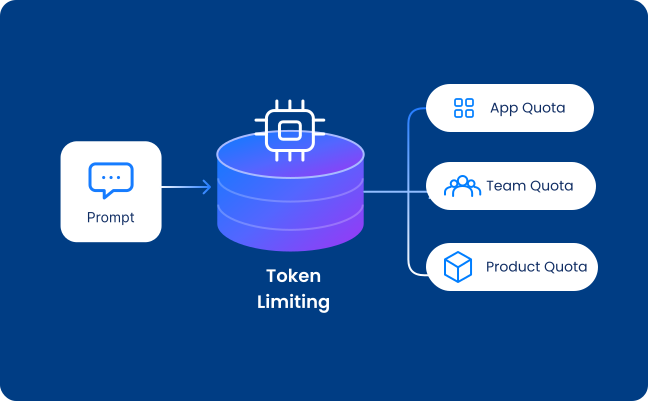
02 / Token Limiting

Enforce AI Budgets in Tokens, Not Requests

Model providers bill by the token, so budgets only hold when the gateway counts tokens too.

  • LLMTokenQuota sets token budgets per app, team, or AI product
  • PromptTokenLimit rejects oversized prompts before they add cost
  • Token tiers attach to API products, so each consumer gets the allowance it signed up for
Token Limiting
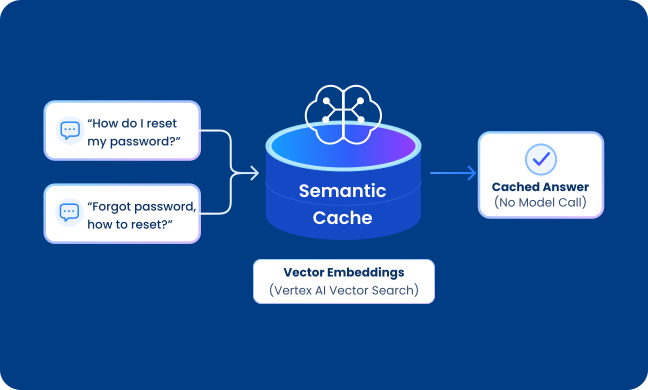
03 / Semantic Cache

Stop Paying Twice for the Same Answer

Users ask the same question in different words. Semantic caching recognizes the meaning, not just the wording.

  • SemanticCacheLookup and SemanticCachePopulate store responses with vector embeddings in Vertex AI Vector Search
  • Prompts close in meaning to a cached one get the stored answer without another model call
  • Similarity thresholds are tuned per use case to balance accuracy and savings
Semantic Cache
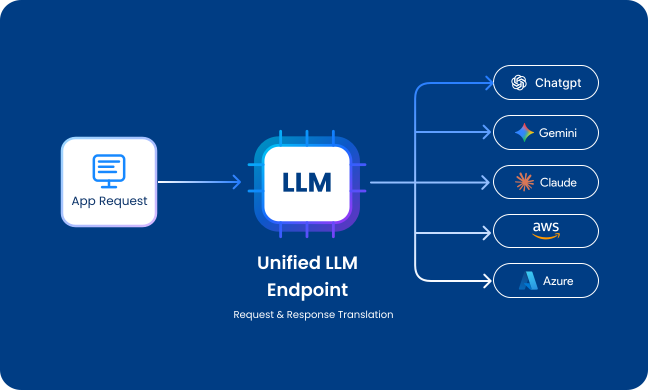
04 / Model Routing

One Endpoint, Every Model

No single model is right for every task, and hard-coding a provider into every app makes change expensive.

  • A unified LLM endpoint puts Gemini, Claude, OpenAI, Amazon Bedrock, Azure, and self-hosted models behind one contract
  • Routing rules send each request to the model that fits its task, cost target, or compliance rule
  • Request and response translation lets teams switch providers through configuration, not code
Model Routing
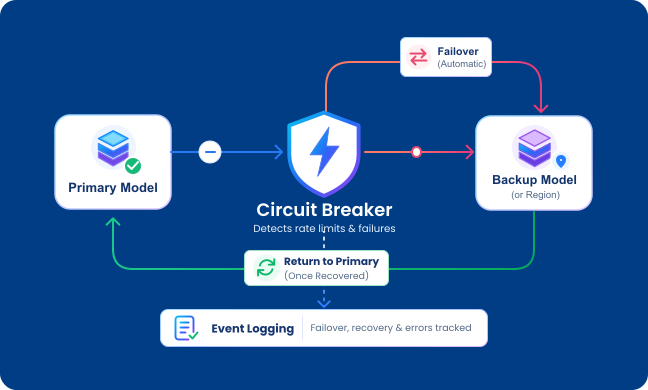
05 / Model Failover

Keep AI Services Running When a Provider Is Not

Rate limits, regional slowdowns, and outages are routine for AI providers. Your customer-facing services should not feel them.

  • The LLM circuit breaker pattern detects rate-limit errors and failing endpoints
  • Traffic fails over to a backup model or region automatically
  • Traffic returns to the primary once it recovers, with every event logged
Model Failover
06 / Agent Governance

Govern Agent-to-Agent and Agent Payment Traffic

When agents hand work to other agents, every hop needs an identity, a scope, and a record.

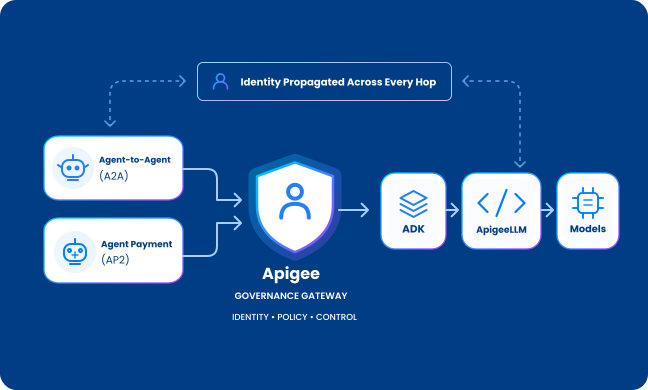
  • A2A and AP2 traffic runs through Apigee with scope-based and method-level authorization
  • Identity is carried across each hop, giving a full chain of who called what
  • Recursive loop prevention, circuit breakers, and SLAs keep multi-agent workflows stable
  • Agents built with ADK reach models through Apigee using the ApigeeLLM interface
Agent Governance
07 / Advanced Analytics and FinOps

See Who Is Spending What, as It Happens

Visibility is what turns AI from an open-ended cost into a managed one.

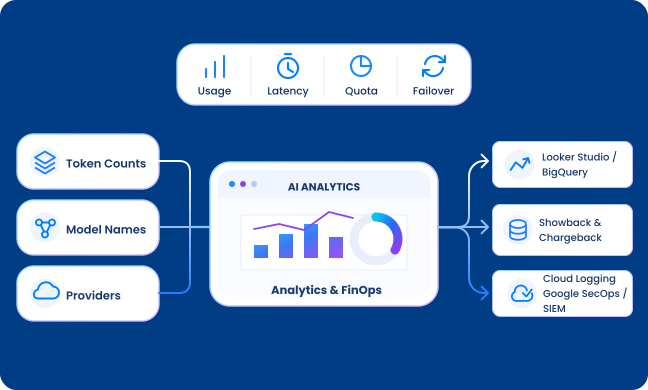
  • Token counts, model names, and providers are available in Apigee custom reports
  • Dashboards in Looker Studio or BigQuery track usage, latency, quota consumption, and failover events
  • Showback and chargeback by business unit, application, or AI product
  • Logs flow to Cloud Logging and to Google SecOps or your existing SIEM
Advanced Analytics and FinOps

Run APIs and AI on
One Apigee Platform

Apigee works as both an API gateway and an AI gateway. If your teams already run APIs on Apigee, AI governance plugs into the API products, developer portal, and security policies you have in place. If you are new to Apigee, you set up both together, with one team, one set of tools, and one approval process for APIs and AI.

Self-Serve AI Products for Developers

Package models and MCP tools as AI products with token-based tiers, and publish them to your developer portal as an internal model garden. Developers subscribe, get credentials, and start building without raising a ticket.

One Catalog for APIs, Tools, and Agents

Apigee API hub catalogs APIs, MCP tools, and agentic skills in one place, with semantic search so developers and agents find the right asset. Integration with Agent Registry keeps agent platforms in sync.

Proven API Security, Extended to AI

OAuth 2.0, JWT validation, API keys, and Advanced API Security protect AI traffic the same way they protect APIs, adding defense against OWASP Top 10 risks for LLMs and APIs without a separate security stack.

AI Proxies Delivered Through CI/CD

AI proxies, shared flows, and policies are versioned in source control and promoted through automated pipelines, the same APIOps model our team uses for API delivery. Configuration stays consistent across every environment.

Ready to Govern Every Model, Tool, and Agent From Apigee?

Share how your teams use AI today. Our Apigee architects will map the traffic, pinpoint the cost and governance gaps, and lay out a practical path to production on Apigee AI Gateway.

Schedule a Consultation
Apigee AI Gateway

Works With the Models and Security Services You Already Use

Apigee connects to leading model providers through one API contract, so teams can switch or combine models without rewriting integrations. It also works with the Google Cloud security services your teams may already run.

Why Partner With NeosAlpha for Apigee AI Gateway

Choosing Apigee as your AI gateway is the first step. Getting real value from it takes a partner who knows Apigee in depth, can connect it to your systems, and can run it in production. Here is what NeosAlpha brings to your Apigee AI program.

Deep Apigee and Google Cloud Expertise

With 10 years as a Google Cloud partner specializing in Apigee, our engineers have deployed and scaled Apigee across OPDK, hybrid, and Apigee X. We know how Apigee works with Model Armor, Vertex AI, API Hub, and Cloud Logging, so your AI gateway fits cleanly into your Google Cloud environment.

Consulting-Led, From Strategy to Execution

Every engagement starts with understanding your business, your current Apigee setup, and what you need AI to achieve. Our consultants identify the AI use cases worth bringing through the gateway and recommend the right mix of Apigee policies, deployment model, and rollout plan to deliver them. We stay with you from strategy through execution, so the gateway design and its delivery come from one team.

Simple to Complex AI Traffic, Fully Connected

Our experts handle everything from a single LLM proxy with token limits to multi-model routing, governed MCP tool catalogs, and A2A governance across many agents. When AI traffic needs data from ERP, CRM, or legacy systems, our integration specialists connect those backends through Apigee, Google Cloud Application Integration, Boomi, and Workato.

Flexible Engagement Models

Every organization is at a different stage, whether Apigee already runs its APIs or not. Start with an AI gateway assessment or proof of value, bring in a dedicated team to implement it, add our Apigee engineers to your platform team, or hand day-to-day operations to us through SLA-based managed services.

Frequently Asked Questions

Apigee AI Gateway is Apigee, Google Cloud's API management platform, used as the governance layer for AI traffic. It sits between your applications or agents and the models, MCP tools, and agents they call, and applies authentication, Model Armor screening, token quotas, routing, and analytics to LLM, MCP, and A2A traffic in one place.

Yes. Apigee can front Gemini and Model Garden models, OpenAI, Azure AI Foundry, Amazon Bedrock, and self-hosted models behind one API contract, with routing rules and automatic failover between providers or regions.

Token quotas and prompt size limits cap spend per consumer, semantic caching answers repeated questions without another model call, and routing sends each request to the most cost-effective model for the task. Token counts by model and provider feed custom reports for showback and chargeback.

Apigee stores model responses alongside a vector embedding of the prompt. When a new prompt is close enough in meaning to a cached one, Apigee returns the stored response without calling the model, saving tokens and reducing latency.

No. Apigee works as both an API gateway and an AI gateway, so you can start with AI traffic alone and bring your APIs onto the same platform later, or extend an existing Apigee setup to cover AI. NeosAlpha supports both paths, from first deployment to day-to-day operations.

Apigee transcodes OpenAPI-described APIs into MCP tools and serves them from an MCP proxy. Tools are grouped into API products, so each agent's tools/list returns only the tools it is approved to call, with authentication and rate limits applied to every call. NeosAlpha helps teams decide which APIs to expose as tools and with what access scopes.

Yes. Apigee supports A2A and AP2 traffic, applies scope-based and method-level authorization to each call, carries identity across agent hops, and logs every exchange. Loop prevention and circuit breakers keep multi-agent workflows from running away.

Most AI gateway capabilities are delivered on Apigee X, and MCP support is also available on Apigee hybrid. Because Google adds AI features regularly, NeosAlpha confirms availability for your version and region during the assessment.

Get in touch

Tell us what you're looking for and we'll get you connected to the right people.

Please fill the form below or send us an email at sales@neosalpha.com